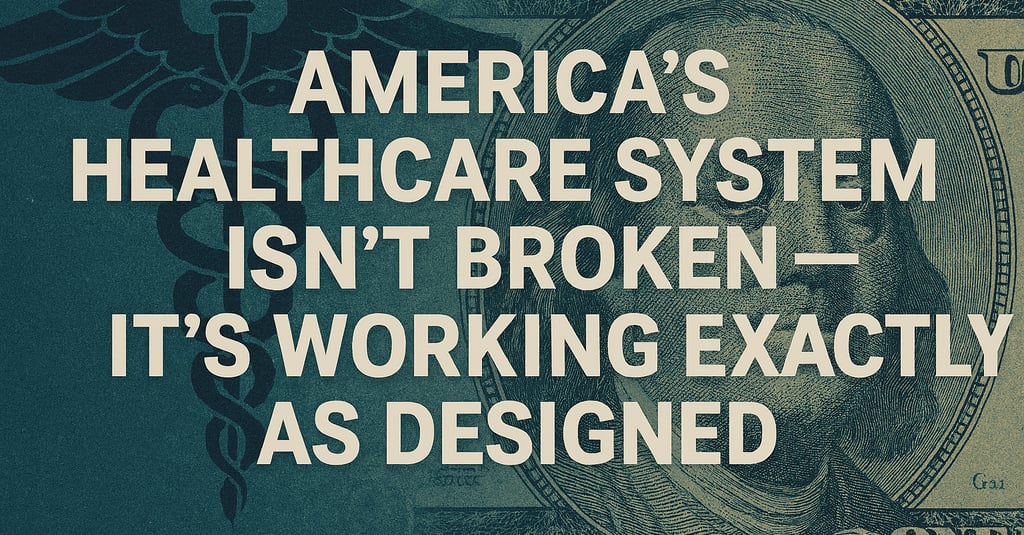
America’s Healthcare System Isn’t Broken
America’s healthcare system isn’t failing by accident — it’s delivering exactly what it was designed to produce. In this article, TX‑30 Independent candidate Oxford “Ox” Nordberg explains why rising costs, consolidation, and complexity aren’t breakdowns, but structural incentives — and why real reform requires redesign, not patches.
Ox Nordberg
3/20/20262 min read
When Americans say the healthcare system is “broken,” they usually mean the same thing: costs are crushing families, care feels inaccessible, and patients are treated like billing codes instead of people. But here’s the uncomfortable truth:
America’s healthcare system is not broken. It’s functioning exactly as it was designed to function.
Just not for patients.
A System That Works — For Powerful Interests
A broken system fails unintentionally. But the U.S. healthcare economy delivers the same outcomes year after year: high prices, limited competition, and extraordinary profits for those with the most political influence. That consistency is not a malfunction — it’s evidence of intent.
Pharmaceutical Companies
In 2025 alone, pharmaceutical and health products companies spent over $341 million on federal lobbying — more than any other industry in America. That spending focused heavily on weakening Medicare’s new authority to negotiate lower drug prices, protecting monopoly pricing structures, and delaying competition.
The result is predictable: U.S. brand‑name drug prices remain three to four times higher than prices paid in other developed nations.
Hospitals
Hospital systems are the largest single category of U.S. healthcare spending. Over the past two decades, hospitals have rapidly consolidated into large regional and national systems. Research consistently shows this consolidation raises prices while failing to improve care quality.
Hospitals and their trade groups are not passive observers. The American Hospital Association alone spent nearly $24 million lobbying in 2025, including more than $7 million in the first quarter pushing legislation affecting reimbursement and competition.
Insurance Companies
Insurers spent more than $130 million lobbying in 2025, shaping the complex billing and reimbursement rules that dominate modern healthcare. Complexity isn’t accidental — it favors middlemen who can navigate it, not patients who must live with the consequences.
Why Patients Always Lose
Every incentive in the system — from pricing to billing to coverage design — is structured around revenue flow between corporations and investors. Patients are not the primary customers of the healthcare system. They are the funding source.
When people experience this system as confusing, expensive, and impersonal, they are not imagining dysfunction. They are encountering a structure that was never designed for their well‑being in the first place.
Why Language Matters
Calling the system “broken” invites cosmetic fixes. It allows powerful interests to argue they are merely “improving” or “innovating,” even while outcomes worsen for families.
But acknowledging the real truth — that the system is working as designed — changes the debate. It shifts attention from symptoms to structure. From apologies to accountability.
And accountability is where real reform begins.
Contact
Email: support@oxforcongress.com
© 2026. All rights reserved.
Paid for by Oxford Nordberg for Congress. Authorized by Oxford Nordberg.
This website and its contents constitute political advertising.
Contact: admin@oxforcongress.com
By subscribing, you agree to receive emails from Oxford Nordberg for Congress. You can unsubscribe at any time. Our mailing address appears in every email.
join the email list